
Mirakl is a seller operations system, not a single API. This guide maps where each lane fails, who owns the fix, and what evidence closes it, across seller onboarding, offer publication, order acceptance, refunds, and settlement.
Book discovery · Read integration services
In this guide
- Seller lifecycle failure map
- Operations evidence matrix
- What to test before launch
- Order and settlement failure modes
- Seller communication and operating lanes
- Metrics and integration boundaries
- FAQs
Marketplace integration is not one API lane
Mirakl projects become fragile when “marketplace integration” is treated as one API lane. It is really a seller operations system: seller onboarding, product data validation, offer publication, order acceptance, shipment, cancellation, refund, commission, and payout. Each lane fails differently and each lane has a different owner.
The expensive failures are not just technical rejects. They are seller accounts stuck in onboarding, offers visible with stale stock, marketplace orders accepted outside OMS capacity, refunds that do not match settlement, or commission disputes without traceable evidence.
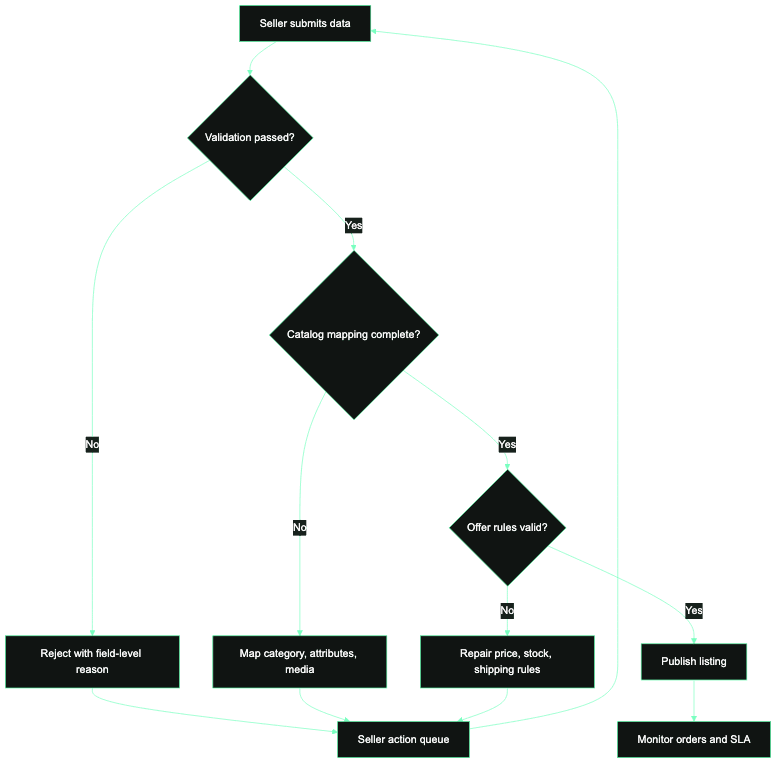
Seller lifecycle failure map
- Seller onboarding: missing legal, tax, banking, shipping, or compliance fields. Owner: marketplace operations.
- Product validation: category mapping, required attributes, image rules, brand restrictions, or localization gaps. Owner: catalog/PIM operations.
- Offer publication: price, stock, lead time, channel eligibility, or publication-window mismatch. Owner: seller operations with integration support.
- Order acceptance: seller SLA, OMS routing, fraud hold, allocation, or cancellation rule. Owner: marketplace order operations.
- Shipment and return: tracking, carrier mapping, return authorization, refund trigger, and customer-service visibility. Owner: operations and support.
- Settlement: commission, payout, refund, chargeback, and invoice evidence. Owner: finance operations.
Operations evidence matrix
Every Mirakl exception should keep the seller id, shop id, SKU or product id, offer id, order id, lifecycle state, error code, owner, replayability, and closure evidence. If the row does not show whether the seller can fix it, marketplace operations can fix it, or engineering must fix the mapping, the dashboard is not actionable.
mirakl_exception:
  seller_id: "seller-481"
  shop_id: "EU-B2B-Tools"
  product_sku: "SPARE-7712"
  offer_id: "offer-99102"
  lifecycle_state: "offer_publication_rejected"
  error_code: "MISSING_REQUIRED_ATTRIBUTE"
  source_system: "PIM export"
  owner: "catalog operations"
  replayable_after_fix: true
  closure_evidence:
    - "attribute repaired in PIM"
    - "offer accepted by Mirakl"
    - "stock visible on commerce PDP"
What to test before launch
Test a seller that passes onboarding and one that fails each required gate. Test a product that fails category mapping, an offer with stale stock, an order that the seller rejects, a shipment with invalid carrier mapping, a refund that arrives after settlement, and a commission adjustment. The pass condition is the owner and evidence trail, not only the API response.
Order and settlement failure modes
Seller onboarding issues are visible early, but order and settlement issues are where marketplaces lose trust. A marketplace order can be accepted in Mirakl while OMS cannot allocate stock, while commerce has the wrong customer-facing status, or while ERP has no commission or invoice reference. The runbook should distinguish five states: order waiting for seller acceptance, order accepted but not routed, shipment confirmed without tracking visibility, refund initiated without settlement match, and payout blocked by commission dispute.
Each state needs a different owner. Seller acceptance belongs to marketplace operations. OMS routing belongs to order operations. Tracking belongs to fulfillment or carrier integration. Refund mismatch belongs to support and finance. Commission dispute belongs to marketplace finance. Engineering supports all of these lanes, but engineering should not be the first owner for every marketplace exception.
For settlement, record the Mirakl order id, seller id, commission rule, payout batch, PSP refund reference if applicable, ERP invoice or credit memo reference, and support case. When those identifiers are not joined, teams end up reconciling seller payouts manually. That is slow and creates risk because sellers can see one version of the transaction while finance closes another.
Seller communication rules
The integration should expose seller-repair messages that operations can use without rewriting technical errors. “Attribute missing” is not enough. The message should say which attribute, which product or offer, which channel, which deadline, and whether the seller can repair it or internal catalog operations must repair it. A seller-facing message is part of the operating model because unclear messages increase support load and slow publication.
For orders, seller communication should be tied to SLA state. If an order is waiting for acceptance, the seller needs a deadline and escalation path. If shipment tracking is invalid, the seller needs the accepted carrier format. If a refund is pending, the seller needs the customer outcome and payout consequence. Good integration design makes these states visible instead of forcing support to infer them from API logs.
Operate with marketplace lanes
The operations board should show separate lanes for seller onboarding, product validation, offer publication, order SLA, refund mismatch, and settlement exceptions. Merge them only for executive reporting. During the working day, teams need separate queues because seller operations, catalog, support, engineering, and finance do not repair the same defects.
Where teams usually lose control
Mirakl operating debt usually appears when the marketplace grows faster than the exception model. The first warning sign is a spreadsheet that tracks seller go-live blockers outside the platform. The second is a support queue where sellers, customers, and finance all report the same order in different language. The third is settlement work that depends on people copying Mirakl ids into ERP or payment reports by hand.
Prevent this by making lifecycle states explicit. A seller should never be “almost live” without a named missing gate. An offer should never be “not showing” without a publication state, rejection reason, and owner. A refund should never be “with finance” without Mirakl order id, PSP reference, settlement batch, and closure decision. Those rules sound operational, but they are integration requirements because the system must expose the evidence.
The same discipline applies to scaling. Adding sellers should not mean adding manual exception work in the same proportion. The test of the marketplace integration is whether seller count, offer count, and order count can grow while the exception queues remain classified, owned, and measurable.
Metrics for marketplace operations
Track metrics by lane, not only by aggregate marketplace revenue. Seller onboarding should show time to approved seller, number of sellers blocked by missing data, and age of each blocker. Product validation should show rejected products by reason, category, seller, and owner. Offer publication should show offers rejected, offers stale, offers visible but not buyable, and offers repaired after seller action. Order operations should show acceptance SLA, cancellation reason, shipment delay, and invalid tracking. Settlement should show unmatched refunds, commission adjustments, payout holds, and aged disputes.
These metrics give each owner a workable queue. They also expose whether the integration is transferring work to humans. If offer publication improves but settlement disputes rise, the marketplace is not healthy. If seller count rises but onboarding blocker age rises faster, operations is under-designed. If support tickets mention order status that Mirakl, commerce, and OMS cannot agree on, status ownership is broken.
Integration boundaries to review
Review four boundaries before go-live. First, seller-to-Mirakl onboarding: required fields, compliance states, banking, tax, and seller messaging. Second, PIM-to-Mirakl product and offer publication: category mapping, required attributes, image rules, stock, price, and lead time. Third, Mirakl-to-commerce order promise: acceptance, cancellation, shipment, tracking, and customer visibility. Fourth, Mirakl-to-finance settlement: commission rules, refunds, payouts, invoices, and dispute handling. Each boundary should have sample successful and failed records.
Mirakl operations checklist
- Separate seller, product, offer, order, return, and settlement exception queues.
- Store seller id, offer id, order id, and settlement reference in every alert.
- Give sellers clear repair messages for data they own.
- Keep marketplace operations responsible for lifecycle-state closure.
- Reconcile refunds and commissions before payout windows close.
- Test seller rejection, late shipment, and refund mismatch scenarios before go-live.
FAQs
Is Mirakl integration mostly a catalog problem?
No. Catalog validation is only one lane. Offer publication, order SLA, shipment, refund, commission, and payout evidence are just as important because they affect customer promise and seller trust.
Who owns seller-facing failures?
Seller operations owns the lifecycle conversation, even when engineering owns the integration fix. Sellers need one accountable path for repair instructions and closure.
What should be visible on the dashboard?
Show seller id, product or offer id, order id, lifecycle state, error code, owner, age, replayability, and closure evidence. Anything less tends to become another ticket queue.
Related pages
- Mirakl integration
- Marketplace and dropship integrations
- ERP and finance integrations
- Integration services
Map seller operations failures.
CCI can review your Mirakl lifecycle lanes and turn seller, offer, order, refund, and settlement exceptions into owned operating queues.
Next step
Turn the article into an execution conversation.
Use the linked integration-audit CTA as the practical follow-through for this topic without turning the page into a wall of extra boxed UI.
Open integration-auditRelated field guides
Marketplace Operations
Marketplace integration guide
Marketplace integration guide
CCI designs Marketplace integration guide with clear ownership, API contracts, monitoring, runbooks, and handoff.

SAP Commerce OAuth client setup checklist for integration teams
A practical checklist for configuring SAP Commerce OAuth clients, grant types, scopes, redirect behavior, and operational controls without creating fragile authentication paths.